
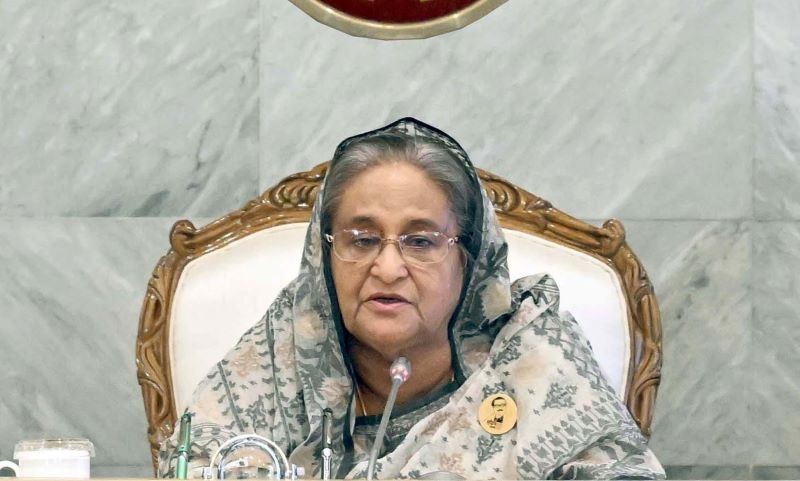
 Sheikh Hasina has called the current regime in Bangladesh 'illegal'. File Photo: PID Bangladesh.
Sheikh Hasina attacks Muhammad Yunus from first public address in Delhi, urges uprising in Bangladesh
Ousted Bangladesh Prime Minister Sheikh Hasina launched a fierce political broadside against Nobel laureate Muhammad Yunus during her first public address in India since leaving Bangladesh in 2024, accusing him of presiding over an “illegal and violent” regime that has plunged the country into chaos and democratic collapse.
Addressing an audience via audio message at the Foreign Correspondents’ Club in Delhi, Hasina framed the ongoing crisis in Bangladesh as a fight for national sovereignty and constitutional survival.
The event, titled Save Democracy in Bangladesh, was attended by several former Awami League ministers and members of the Bangladeshi diaspora.
Although she did not appear in person, Hasina’s speech, broadcast to a packed hall, was uncompromising in tone.
She repeatedly denounced Yunus as a “murderous fascist,” “money launderer,” and “traitor,” accusing him of serving foreign interests and driving Bangladesh toward instability and conflict.
“Bangladesh stands today on the edge of an abyss,” Hasina said, invoking the legacy of the 1971 Liberation War and her father, Sheikh Mujibur Rahman.
She described the country as having been transformed into “a vast prison and execution ground,” alleging widespread human rights abuses, suppression of press freedom, and unchecked violence against women and religious minorities.
Hasina said she was forcibly removed from office on August 5, 2024, in what she called a “carefully orchestrated conspiracy.” Since then, she claimed, democracy has been “exiled,” law and order have collapsed, and citizens face insecurity amid mob violence, looting, and extortion across both urban and rural areas.
Her strongest accusations targeted Yunus personally, alleging that he has drained the nation’s resources and compromised its sovereignty by bartering territory and strategic interests to foreign powers.
She warned that Bangladesh was being pushed toward a “multinational conflict” through what she described as acts of betrayal.
The speech also served as a call to action.
Hasina urged democratic, progressive and pro-Liberation forces to unite and overthrow what she termed a “foreign-backed puppet administration,” invoking Liberation War-era slogans and symbolism. The address concluded with chants of “Joy Bangla” and “Joy Bangabandhu.”
Positioning the Awami League as the sole legitimate guardian of Bangladesh’s democratic and pluralist traditions, Hasina said the party remained inseparable from the nation’s political identity and vowed to help restore what she described as a “thriving homeland that was stolen from the people.”
She outlined five demands, beginning with the removal of the Yunus-led administration and the restoration of conditions for free and fair elections.
She also called for an end to street violence, firm guarantees for the safety of minorities and women, an end to what she described as politically motivated legal persecution of opposition figures and journalists, and the restoration of judicial independence.
Her final demand was for a fresh, “truly impartial” United Nations investigation into developments over the past year, arguing that only an independent international probe could establish the truth and help the country move forward.
“The international community stands with you,” Hasina told her supporters, insisting that the interim government had lost legitimacy by ignoring the will of the people.
The speech highlighted the deep polarisation gripping Bangladeshi politics, with Hasina portraying the current crisis not as a routine political transition but as a fundamental struggle between the ideals of the Liberation War and what she described as extremism, authoritarianism and foreign interference.
For many in attendance, the address carried symbolic significance as Hasina’s first public political intervention from India, signalling her intention to continue shaping Bangladesh’s political narrative from abroad.
Whether her appeal for mass mobilisation and international intervention gains momentum remains uncertain. But her message was unequivocal: “Do not give up. Join the fight to reclaim our nation and rebuild democracy in Bangladesh.”
Top Headlines
-
News
Smit Machchhar: Bleeding on the Cockpit Floor, the Indian Captain Opened the Door That Saved 174 Lives
October 01, 2026
-
News
Sona College of Tech, Salem team wins Mitsubishi contest for factory automation; beats 6 national winners across Asia
September 20, 2026
-
News
After days of silence, China confirms Xi Jinpings India visit for BRICS Summit
September 10, 2026
-
News
ISKCON Juhu in trouble: FDA suspends licences of 3 restaurants over serious hygiene violations
September 09, 2026
-
News
Sona College of Technology's 25th graduation day: 1,325 students receive BE, BTech, ME, MCA, MBA and PhD degrees
September 09, 2026
-
News
Air India sacks Phuket-Delhi pilot who tested positive for psychoactive substance
September 04, 2026
-
News
Gloria Steinem, who gave second-wave feminism its face and its argument, dies at 92
September 04, 2026
-
News
Rs 20 bribe case ends after 30 years as Supreme Court acquits Gujarat employees
August 19, 2026
-
News
RG Kar rape-murder case takes fresh turn as ex-TMC MLA Nirmal Ghosh arrested over cremation probe
August 13, 2026
-
News
Vijay-Sangeetha divorce case closed as wife withdraws petition
August 07, 2026