

 Sheikh Hasina
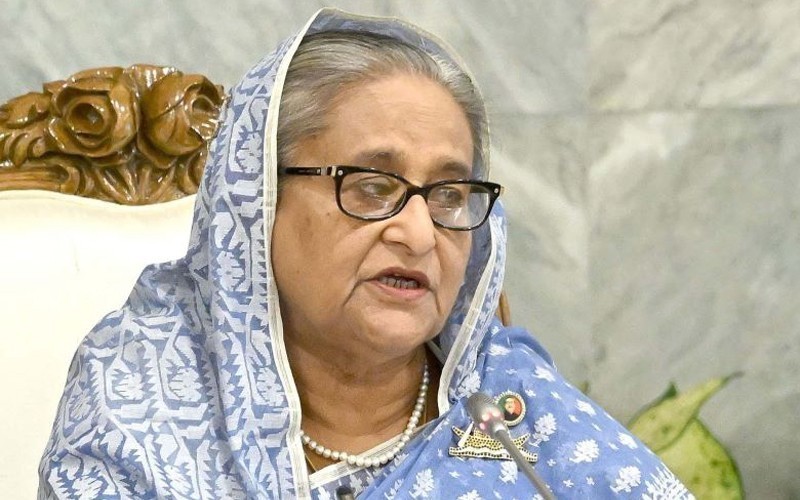
Ousted Bangladesh Prime Minister Sheikh Hasina. Photo: X/PID
Sheikh Hasina
Ousted Bangladesh Prime Minister Sheikh Hasina. Photo: X/PID
'Rigged tribunal': Sheikh Hasina's first reaction after being sentenced to death for 'crimes against humanity'
Dhaka/IBNS: Ousted Bangladesh Prime Minister Sheikh Hasina has issued a scathing rejection of the death penalty announced against her by the International Crimes Tribunal (ICT), calling the ruling the outcome of a “rigged tribunal” functioning under an “unelected government with no democratic legitimacy.”
In a detailed written statement, released minutes after the verdict, Hasina accused the Muhammad Yunus-led interim administration of orchestrating a politically motivated prosecution designed to destroy her and dismantle the Awami League, her party that dominated national politics for over a decade.
She reiterated that the charges—connected to the deadly student uprising of July–August 2024—were fabricated and that the judicial process lacked even the minimum standards of due process.
According to Hasina, the verdict was “pre-decided,” claiming that “no credible or professional jurist anywhere in the world would endorse the Bangladesh ICT.”
Hasina accuses interim govt of political persecution
Hasina levelled sharp criticism at the interim government headed by Nobel laureate Dr Muhammad Yunus, alleging that extremist factions within the administration are driven by a “brazen and murderous intent” to eliminate her from national politics.
She claimed the ruling was engineered to divert attention from what she described as the interim government’s failures.
She argued that under Yunus’s leadership, Bangladesh has plunged into “chaotic, violent and socially regressive” governance, pointing to attacks on minorities, widespread repression of dissent, and a collapse in essential public services.
Claims of denial of fair trial
A central theme of Hasina’s rebuttal is her assertion that she was denied a fair trial.
She said she was not permitted to appoint her own defence lawyers or present evidence in her favour.
“I am prepared to face my accusers in a genuine tribunal where evidence is examined fairly,” she stated, urging the matter be taken to the International Criminal Court.
Rebuttal of allegations on 2024 crackdown
On allegations of ordering lethal force during the 2024 student protests, Hasina argued that security operations were conducted “in good faith” amid escalating unrest, insisting that operational decisions were made by field commanders and not dictated by her office.
She accused prosecutors of using “fragmentary” and “contextless” material while ignoring evidence of provocateurs and armed agitators involved in the unrest.
She also disputed the widely reported casualty figures from the July Uprising, claiming the interim government shut down an independent judicial inquiry she had initiated to establish an accurate account of events.
Framing verdict as part of a 'larger political battle'
Hasina contrasted her 15-year tenure—marked, in her view, by economic expansion and advances in human rights—with what she described as a campaign of vengeance carried out by the interim regime’s “cronies.”
She framed the tribunal’s decision as part of a systematic effort to erase her political legacy and weaken her party.
Her statement marks the strongest pushback yet since the tribunal handed down its verdict, intensifying the political confrontation surrounding Bangladesh’s turbulent transition and raising international questions about the integrity of the judicial process.
Death sentence for 'crimes against humanity'
Earlier, Bangladesh’s ICT sentenced Sheikh Hasina to death, ruling that she committed "crimes against humanity".
The verdict came after months of proceedings that concluded Hasina ordered a violent crackdown on a student-led uprising last year — unrest that ultimately brought down her Awami League government.
The three-judge bench, led by Justice Md Golam Mortuza Majumder, also convicted two of Hasina’s closest associates: former Home Minister Asaduzzaman Khan Kamal and former police chief Chowdhury Abdullah Al-Mamun.
According to the tribunal, all three acted together to carry out widespread attacks intended to kill protesters across the country.
Hasina and Kamal, both declared fugitives, were tried in absentia. Mamun appeared before the court initially but later became an approver.
Top Headlines
-
News
Air India sacks Phuket-Delhi pilot who tested positive for psychoactive substance
September 04, 2026
-
News
Gloria Steinem, who gave second-wave feminism its face and its argument, dies at 92
September 04, 2026
-
News
Rs 20 bribe case ends after 30 years as Supreme Court acquits Gujarat employees
August 19, 2026
-
News
RG Kar rape-murder case takes fresh turn as ex-TMC MLA Nirmal Ghosh arrested over cremation probe
August 13, 2026
-
News
Vijay-Sangeetha divorce case closed as wife withdraws petition
August 07, 2026
-
News
Journalist harassment during CJP protest: Kolkata Police recreate crime scene with barefoot accused
July 27, 2026
-
News
Reliance Industries posts record quarterly revenue of 3.4 lakh crore, Jio IPO on the horizon
July 17, 2026
-
News
'Mannat is a private property': Supreme Court clears renovation of Shah Rukh Khan's Bandra residence
July 14, 2026
-
News
I will return this year: Ex-Bangladesh PM Sheikh Hasinas bold comeback claim, sends strong message to current government
June 28, 2026
-
News
'Look inwards': India's sharp reply to Pakistan over Karachi terror allegations
June 28, 2026