
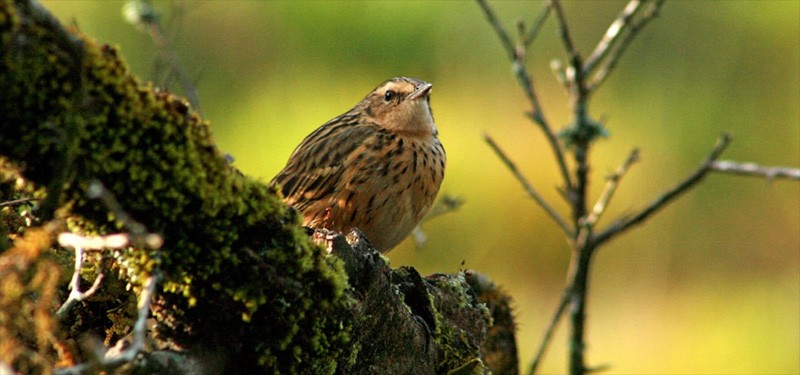
 A Nilgiri pipit, the only grassland specialist species that was part of the study. Image by P. Jeganathan via Wikimedia Commons (CC BY-SA 4.0).
Disappearing Nilgiri grasslands impact bird populations
A study of the shola sky islands in the southern Western Ghats finds that land-use changes are reshaping bird movements, with both forest and grassland species avoiding human-dominated areas. Forest specialists were less affected in woodlands invaded by woody plants, while the Nilgiri pipit, the study’s only grassland specialist, faced the greatest movement constraints from woody invasions and human activity. Mongabay India correspondent Simrin Sirur reports
Up in the Nilgiris, Tamil Nadu, the gradual disappearance of the region’s shola grasslands has changed how birds navigate the landscape, highlighting the importance of habitat connectivity in preserving endemic biodiversity.
The shola sky islands are unique montane forests separated by rolling grasslands. They’re biologically significant because they host a large number of species whose global distributions are concentrated here.
But changes in land use dynamics have caused a steady decline in the populations of certain birds in the region. Colonial-era plantations of exotic tree species like Acacia, Eucalyptus and Pinus, which are not native to this region, have invaded several parts of the sky islands. Between 1973 and 2017, the islands lost 516 sq km of grasslands and 63 sq km of forests.
The shola sky islands are unique montane forests separated by rolling grasslands. They’re biologically significant because they host a large number of species whose global distributions are concentrated here.
But changes in land use dynamics have caused a steady decline in the populations of certain birds in the region. Colonial-era plantations of exotic tree species like Acacia, Eucalyptus and Pinus, which are not native to this region, have invaded several parts of the sky islands. Between 1973 and 2017, the islands lost 516 sq km of grasslands and 63 sq km of forests.
These diminished habitats have also exposed the limits of adaptability for birds. “Highlighting how land-use change shapes species’ connectivity provides a window into how species specialised to high-elevation grassland habitat types respond to habitat alterations,” said Chiti Arvind, Postdoctoral Fellow, IISER Tirupati and a co-author of a research paper studying the impacts of land use change in the shola sky islands on bird movements.
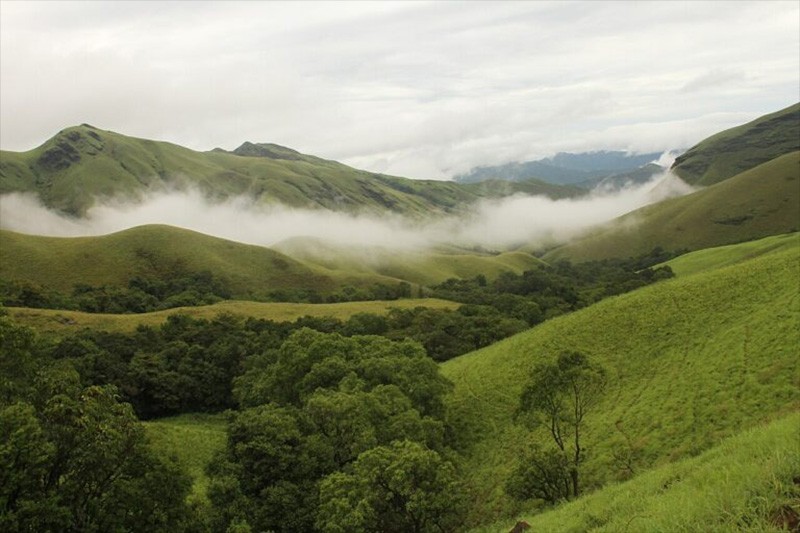 Shola forests and grasslands in the Nilgiris. Image by Davidvraju via Wikimedia Commons (CC BY-SA 4.0).
Gains and losses
The study covered approximately 2,900 sq km across the two largest sky islands — in the Nilgiris and Palani-Anamalais — at elevations higher than 1400 metres above sea level. The objective was to observe how habitat fragmentation impacted the movements of the seven most commonly found species endemic to the region.
These species comprised both forest and grassland specialists, whose requirements differ despite occupying the same spaces. While grassland species require open spaces to forage, nest, and roost, forest specialists are better adapted to woody habitats.
The six forest specialists were the white-bellied sholakili, Palani laughingthrush, the Nilgiri sholakili, the Nilgiri laughingthrush the black-and-orange flycatcher and the Nilgiri flycatcher. Only one grassland specialist was included, the Nilgiri pipit, because it was the only endemic species found at that elevation for which there was sufficient data.
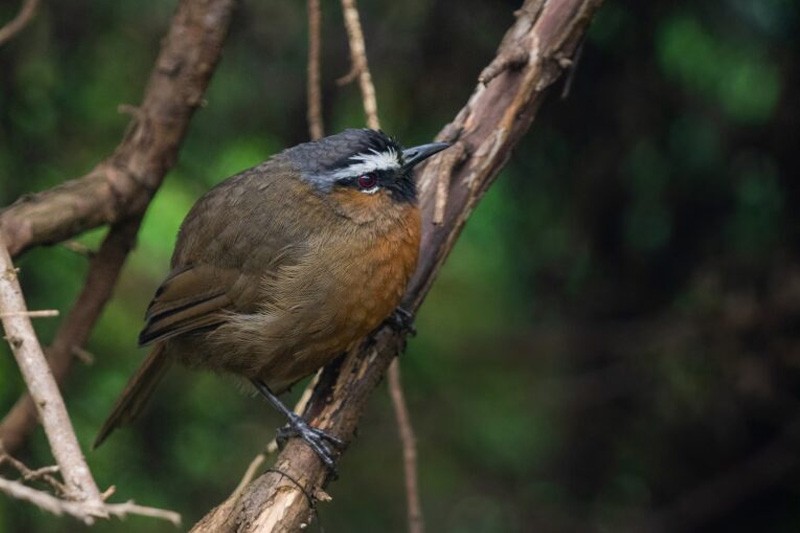 A Nilgiri laughingthrush spotted in Kotagiri, Tamil Nadu. Image by Sidharth Srinivasan via Wikimedia Commons (CC BY-SA 4.0).
In the absence of detailed and historical field data, the researchers quantified species behaviour and built 126 models which predicted the movement patterns of each of the seven species across various scenarios. They found that while both forest and grassland species tended to avoid human-dominated landscapes (such as agriculture, tea plantations, and settlements), their behaviours diverged when it came to areas invaded by woodlands.
“Since the Shola landscape alternates between forests/woodlands and grasslands, an increase in woodland cover implies a corresponding decrease in grassland, resulting in more fragmented natural grassland habitat and a subsequent decrease in connectivity for grassland species,” said Arunima Jain, Project Student at IISER Tirupati who also contributed to the research.
Compared to the forest specialists, the Nilgiri pipit’s movements were hindered across most of the study area, regardless of location. Separate studies have found the Nilgiri pipit’s population to have suffered the steepest declines in recent decades.
The prolonged isolation of this species could impact its genetic diversity in the future due to inbreeding. “Future studies examining genetic connectivity across populations of these species are needed to determine whether these habitat changes have actually reduced gene flow and whether there is a risk of isolation,” said Arvind.
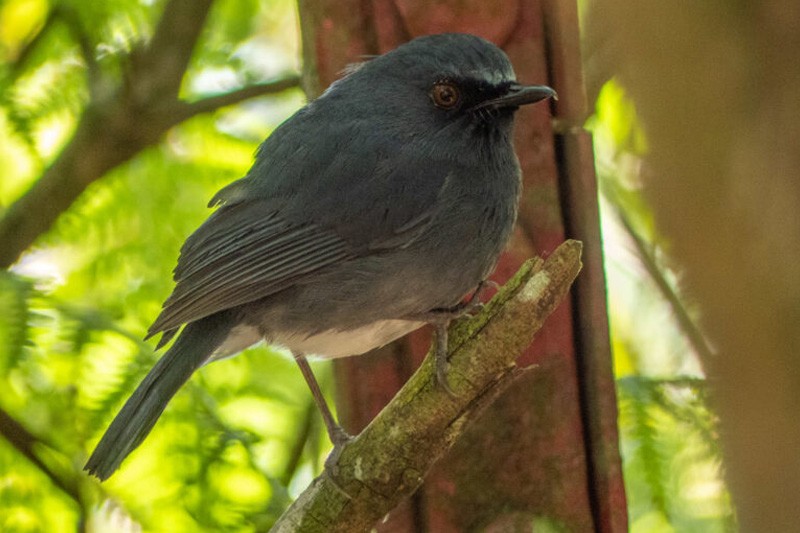 A white-bellied sholakili spotted in the Western Ghats. Image by Mike Prince via Flickr (CC BY 2.0).
A pattern seen beyond the Nilgiris
Although the study does not attribute the isolation of the Nilgiri pipit solely to woody invasions, it joins a growing body of evidence that shows the potential fallouts of plantation activity on native biodiversity.
In Maharashtra, for example, researchers found similar results of how afforestation on grasslands changed the composition of species occupying the landscape. Because woody tree plantations changed the level of understorey required for grassland birds to roost, nest, and forage, their populations inadvertently declined. Forest specialists, on the other hand, populated the landscape instead.
Birds are also significant bioindicators of the health of a habitat. The forest and grassland mosaic structure of the sky islands has made it a rich reservoir of water which replenishes streams. The loss of grasslands, however, has diminished soil quality and reduced its water retention capacity.
“Different species occupying the same spaces can have vastly different survival and movement requirements. We also emphasise the need to restore and preserve vanishing native grassland habitat specifically in the Shola Sky Islands of the Western Ghats. The results of our study, along with those of many others conducted in this landscape, can be used to identify priority areas for restoration,” said V.V. Robin, Associate Professor at IISER Tirupati.
Mongabay India/TWF
Top Headlines
-
Environment
Buniyaad Comes Home Again: Forty Years On, a Partition Epic Finds Its Way to YouTube
October 15, 2026
-
Environment
Disappearing Nilgiri grasslands impact bird populations
August 24, 2026
-
Environment
A Wild Success? Tracking a Decade of Rhino Reintroduction in Manas
May 12, 2026
-
Environment
Cycling for Clean Air? Indias Riders Still Battle Dust, Danger and Neglect
May 12, 2026
-
Environment
Prabha Khaitan Foundation and WWF-India to celebrate the unsung guardians of India's forest and wildlife
March 21, 2026
-
Environment
Snow Leopards and Dogs: How Himalayan Carnivores Rewire Survival in Spiti
February 17, 2026
-
Environment
Gir No Longer Home to Most Asiatic Lions
January 16, 2026
-
Environment
From Dust to Life: How Tal Chhapar Became Indias Grassland Revival Blueprint
December 18, 2025
-
Environment
From Nets to Lifelines: The Rising Whale Shark Rescue Movement Across Indias West Coast
November 29, 2025
-
Environment
Indi Setu: Wildlife on the Brink: Can We Rewild a Warming World?
October 25, 2025