

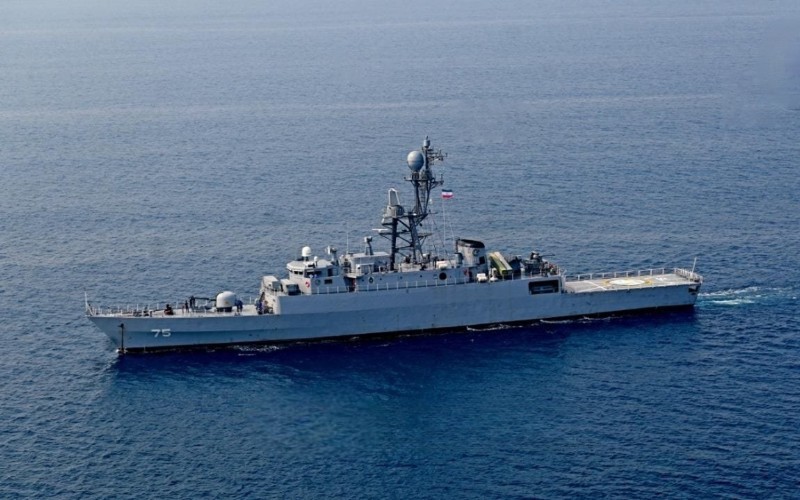
 IRIS Dena
Iranian naval frigate IRIS Dena. Photo: X/@IN_HQENC
IRIS Dena
Iranian naval frigate IRIS Dena. Photo: X/@IN_HQENC
'Guest of India struck in international waters': Iran furious after US submarine torpedoes IRIS Dena
Iran has strongly condemned the United States after a US submarine torpedoed and sank the Iranian naval frigate IRIS Dena in "international waters" in the Indian Ocean, an attack Tehran described as an “atrocity at sea”.
The strike killed dozens of Iranian sailors and significantly escalated tensions in the ongoing conflict involving Iran, the United States and Israel.
According to Iranian officials, the vessel was operating in international waters roughly 2,000 miles from Iran’s coastline when the attack occurred.
Tehran has warned that Washington will “bitterly regret” setting what it calls a dangerous precedent in maritime warfare.
https://t.co/PiqQpVIrMu pic.twitter.com/Wc1e0B0um7
— Department of War 🇺🇸 (@DeptofWar) March 4, 2026
The incident has intensified fears that the conflict, already spreading across the Middle East, could now extend deeper into the Indian Ocean region.
'Guest of India' struck
Iran’s Foreign Minister Abbas Araghchi criticised the strike in a statement on social media, stressing that the frigate had recently taken part in naval exercises hosted by India.
Araghchi described the vessel as “a guest of India’s Navy”, noting that it carried nearly 130 sailors at the time of the attack
He accused the United States of striking the ship without warning while it operated in international waters.
The U.S. has perpetrated an atrocity at sea, 2,000 miles away from Iran's shores.
— Seyed Abbas Araghchi (@araghchi) March 5, 2026
Frigate Dena, a guest of India's Navy carrying almost 130 sailors, was struck in international waters without warning.
Mark my words: The U.S. will come to bitterly regret precedent it has set. pic.twitter.com/cxYiI9BLUk
“The United States has perpetrated an atrocity at sea,” Araghchi wrote, adding that Washington’s actions had created a dangerous precedent.
He warned that the United States would ultimately regret the attack.
The frigate had participated in a joint naval exercise with the Indian Navy only weeks before the incident, according to Iranian officials.
Casualties and rescue operations underway
Authorities in Sri Lanka confirmed that several survivors from the destroyed vessel were brought ashore for medical treatment.
Survivors are currently recovering in a hospital in Galle, a major port city on the island’s southern coast.
Officials said at least 32 sailors were rescued and admitted to hospital with minor injuries. Medical staff indicated that most could be discharged soon.
https://t.co/J4grAgoqxc pic.twitter.com/szOofLkh9W
— Department of War 🇺🇸 (@DeptofWar) March 4, 2026
However, search and rescue operations remain ongoing for approximately 60 crew members who remain missing following the submarine strike.
Rescue teams continue to scan nearby waters in hopes of locating additional survivors.
Security personnel have been stationed around the hospital ward where the rescued sailors are being treated while doctors and nurses continue medical assessments.
First US torpedo strike since World War II
The attack marked a historic moment in modern naval warfare.
According to US officials, it represents the first time an American submarine has sunk an enemy vessel using a torpedo since World War II.
Speaking at the Pentagon, US Defence Secretary Pete Hegseth confirmed the strike and defended the military operation.
Hegseth said the Iranian vessel believed it was operating safely in international waters but was destroyed by a torpedo launched from an American submarine.
.@SECWAR “In the Indian Ocean—an American submarine sunk an Iranian warship, that thought it was safe in international waters.
— DOW Rapid Response (@DOWResponse) March 4, 2026
Instead, it was sunk by a torpedo—Quiet Death.
The first sinking of an enemy ship by a torpedo since World War 2. Like in that war—back when we were… pic.twitter.com/Y97YQBxQza
“An American submarine sank an Iranian warship that thought it was safe in international waters,” he said, adding that the vessel met a “quiet death” beneath the waves.
The Pentagon also released video footage that it said captured the moment of the attack.
The footage reportedly shows a powerful explosion tearing through the rear section of the warship, lifting the vessel partially out of the water before it began sinking from the stern.
Conflict expands beyond Persian Gulf
The sinking of the warship marks a dramatic expansion of the ongoing conflict.
While previous confrontations had largely centred around the Persian Gulf, the latest strike occurred hundreds of miles away in the wider Indian Ocean.
The war began after coordinated military actions by the United States and Israel targeted key Iranian military infrastructure.
The campaign included strikes on missile facilities and nuclear-related sites.
The conflict intensified further after the assassination of Iran’s supreme leader Ali Khamenei, an event that triggered a series of retaliatory missile and drone attacks by Tehran.
Both sides have since exchanged strikes, raising fears that the confrontation could evolve into a prolonged regional war.
JUST IN — 🇮🇷🇺🇸🇮🇱 Robat Karim - a city south of Tehran pic.twitter.com/I4Vs7f0ETM
— UK Report (@UK_REPT) March 5, 2026
Uncertain timeline for military operations
US military officials have not provided a clear timetable for the ongoing campaign against Iran.
During his Pentagon briefing, Hegseth suggested that operations could continue for several weeks.
He noted that while some estimates suggest a four-week timeframe, the campaign could last longer depending on battlefield developments.
According to the defence secretary, US forces intend to maintain pressure on Iranian military capabilities.
Hegseth said the United States would control the pace of the conflict, adding that Iranian forces were currently “off balance”.
American and Israeli officials have also claimed that Iranian missile and drone launches have declined in recent days as airstrikes destroyed launchers and other key equipment.
While the Iranian regime indiscriminately targets civilians with missiles and drones, U.S. forces continue to aggressively hunt and destroy Iranian missile launchers with precision. pic.twitter.com/1RIhMcg0Jm
— U.S. Central Command (@CENTCOM) March 4, 2026
Rising death toll
The escalating war has already resulted in significant casualties across the region.
According to Iran’s Foundation of Martyrs and Veterans Affairs, at least 1,045 people have been killed in Iran since the conflict began.
Israeli authorities reported that eleven people have died in Israel during Iranian retaliatory strikes.
The United States has also suffered casualties. Six American troops have been killed in the fighting, including a major whose identity was released earlier this week.
Top Headlines
-
News
Smit Machchhar: Bleeding on the Cockpit Floor, the Indian Captain Opened the Door That Saved 174 Lives
October 01, 2026
-
News
Sona College of Tech, Salem team wins Mitsubishi contest for factory automation; beats 6 national winners across Asia
September 20, 2026
-
News
After days of silence, China confirms Xi Jinpings India visit for BRICS Summit
September 10, 2026
-
News
ISKCON Juhu in trouble: FDA suspends licences of 3 restaurants over serious hygiene violations
September 09, 2026
-
News
Sona College of Technology's 25th graduation day: 1,325 students receive BE, BTech, ME, MCA, MBA and PhD degrees
September 09, 2026
-
News
Air India sacks Phuket-Delhi pilot who tested positive for psychoactive substance
September 04, 2026
-
News
Gloria Steinem, who gave second-wave feminism its face and its argument, dies at 92
September 04, 2026
-
News
Rs 20 bribe case ends after 30 years as Supreme Court acquits Gujarat employees
August 19, 2026
-
News
RG Kar rape-murder case takes fresh turn as ex-TMC MLA Nirmal Ghosh arrested over cremation probe
August 13, 2026
-
News
Vijay-Sangeetha divorce case closed as wife withdraws petition
August 07, 2026