

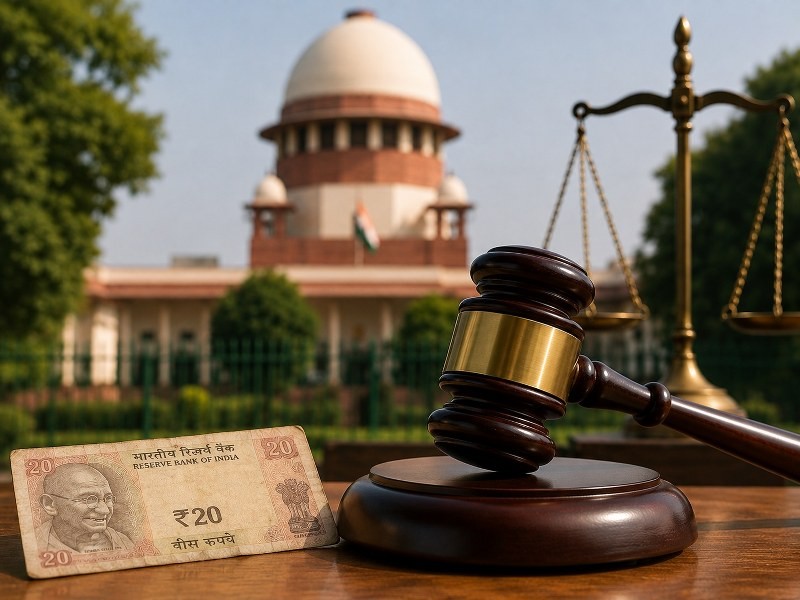
 A three-decade-old Rs. 20 bribery case ended with the Supreme Court acquitting two Gujarat government employees. Photo: ChatGPT
Rs 20 bribe case ends after 30 years as Supreme Court acquits Gujarat employees
A three-decade-old corruption case involving an alleged Rs 20 bribe has finally come to an end, with the Supreme Court acquitting two Gujarat government employees and setting aside their convictions, media reports said.
A bench of Justices Ujjal Bhuyan and Atul S Chandurkar ruled that the conviction of a clerk and a peon could not be sustained merely because Rs 20 was recovered from the peon when the prosecution had failed to establish that a bribe had actually been demanded.
Case began over income certificate
The case dates back to February 1996, when a student approached the Bechari Gram Panchayat office in Gujarat's Anand district to obtain an income certificate needed to avail educational concessions.
According to the prosecution, the clerk allegedly demanded Rs 120 for issuing the certificate — Rs 100 for himself and Rs 20 for the peon.
The student subsequently approached the Anti-Corruption Bureau (ACB), which organised a trap.
The student was provided marked currency notes totalling Rs 120 and was instructed to hand over the money if a demand was made.
Only Rs 20 recovered
After receiving the income certificate, the student handed Rs 20 to the peon. The ACB team subsequently recovered the same marked notes from him.
However, the remaining Rs 100 was never recovered from the clerk.
The Supreme Court found this aspect significant, particularly because the ACB had instructed the student to hand over the entire Rs 120 if the alleged demand was made.
The bench also questioned why the remaining amount was not paid when the clerk was allegedly present next to the peon at the time the Rs 20 was handed over.
Student's statements raise doubts
The court noted inconsistencies in the student's account of the alleged demand.
In a separate statement, the student had reportedly said that the accused initially demanded Rs 200 and later agreed to accept Rs 120. However, this version did not form part of his testimony before the trial court. History
During cross-examination, the student also admitted that the peon himself had never demanded a bribe from him.
The court further noted that the Rs 20 was handed over only after the income certificate had already been issued.
Peon's Eid explanation found plausible
The peon had maintained that the student gave him Rs 20 because Eid was approaching the following day.
The Supreme Court found this explanation more reasonable in light of the circumstances and the absence of proof that the peon had demanded a bribe.
The bench held that the prosecution's case contained enough inconsistencies and gaps to create serious doubt about the alleged transaction.
Recovery alone not enough, says Supreme Court
The court also examined the legal presumption under Section 20 of the Prevention of Corruption Act.
It held that where the prosecution fails to establish the initial demand for a bribe, the mere recovery of money from an accused cannot, by itself, sustain a corruption conviction.
In this case, the recovery of Rs 20 from the peon therefore did not establish the prosecution's allegation of bribery. History
Clerk's prosecution sanction also invalid
The Supreme Court found another legal flaw in the case concerning the sanction required to prosecute the clerk.
According to the bench, the sanction had been granted by an unauthorised officer and was therefore invalid.
This further weakened the prosecution's case against the clerk.
Supreme Court sets aside convictions
The top court ultimately set aside the judgments of both the trial court and the Gujarat High Court and acquitted the two employees.
The ruling brings to a close a legal battle that began in 1996 — over an alleged Rs 20 bribe that took nearly 30 years to reach its final conclusion.
Top Headlines
-
News
VeeCycle Works Signs MoU with AP Govt for Rs 150 Cr Recycling Project in Visakhapatnam
October 12, 2026
-
News
Smit Machchhar: Bleeding on the Cockpit Floor, the Indian Captain Opened the Door That Saved 174 Lives
October 01, 2026
-
News
Sona College of Tech, Salem team wins Mitsubishi contest for factory automation; beats 6 national winners across Asia
September 20, 2026
-
News
After days of silence, China confirms Xi Jinpings India visit for BRICS Summit
September 10, 2026
-
News
ISKCON Juhu in trouble: FDA suspends licences of 3 restaurants over serious hygiene violations
September 09, 2026
-
News
Sona College of Technology's 25th graduation day: 1,325 students receive BE, BTech, ME, MCA, MBA and PhD degrees
September 09, 2026
-
News
Air India sacks Phuket-Delhi pilot who tested positive for psychoactive substance
September 04, 2026
-
News
Gloria Steinem, who gave second-wave feminism its face and its argument, dies at 92
September 04, 2026
-
News
Rs 20 bribe case ends after 30 years as Supreme Court acquits Gujarat employees
August 19, 2026
-
News
RG Kar rape-murder case takes fresh turn as ex-TMC MLA Nirmal Ghosh arrested over cremation probe
August 13, 2026